Dehumidification Technology
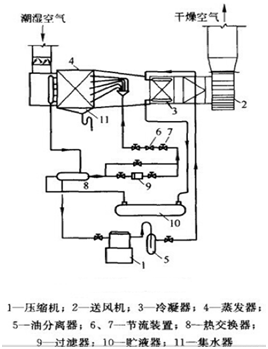
1. Refrigeration Dehumidification
Principle: The cooling and dehumidifying capacity of the evaporator in a refrigeration system is used to remove moisture from the air. The air first passes through the evaporator to be cooled and dehumidified, then through the condenser and other components to be heated.
Advantages: Low energy consumption, simple operation, easy control, and wide applicability.
Scope of Application: For use in environments above the dew point.
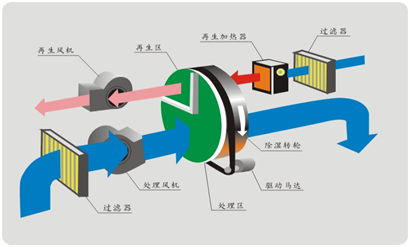
2. Rotary Dehumidification
Principle: A honeycomb-shaped rotary wheel composed of a special ceramic fiber carrier and active silica gel is used. The two sides of the rotary wheel are divided into two areas by special sealing devices: the processing area and the regeneration area. When humid air requiring dehumidification passes through the rotary wheel's processing area, the vapor is adsorbed by the rotary wheel's active silica gel. The dried air is then delivered by the processing fan to the space requiring treatment. Meanwhile, the continuously rotating rotary wheel carries the vapor nearing saturation into the regeneration area. Within the regeneration area, high temperature air blown in the opposite direction desorbs the moisture adsorbed within the rotary wheel. This moisture is expelled outdoors by a fan, restoring the rotary wheel's moisture-absorbing capacity and completing the regeneration process. The rotary wheel continues to rotate continuously.
Advantages: No refrigerant required, high efficiency, large dehumidification capacity, easy operation, safety and reliability.
Scope of Application: Environments with significant fluctuations in air humidity, low-temperature dehumidification, and high-airflow humid locations.
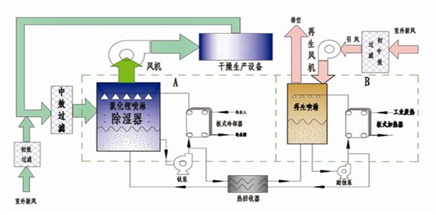
3. Solution Dehumidification
Principle: An innovative air conditioning product developed based on active dehumidification air handling technology—which regulates air humidity using a dehumidifying solution as a desiccant and adjusts air temperature using water as a refrigerant—enabling fresh air operation. Its core lies in leveraging the physical properties of the desiccant through an innovative solution-based dehumidification and regeneration method.
Advantages: Simple manufacturing, reliable operation, energy conservation and high efficiency.
Scope of Application: Efficient dehumidification above the dew point temperature.
4. Duct Dehumidification
Principle: An evaporator is used to cool and dehumidify the air while recovering the system's condensation heat to compensate for the heat lost during the cooling and dehumidification process.
Advantages: High efficiency
Scope of Application: A duct-based temperature and humidity control method and its equipment capable of heating, cooling, and dehumidifying indoor spaces under varying indoor and outdoor temperatures to meet indoor temperature and humidity requirements.