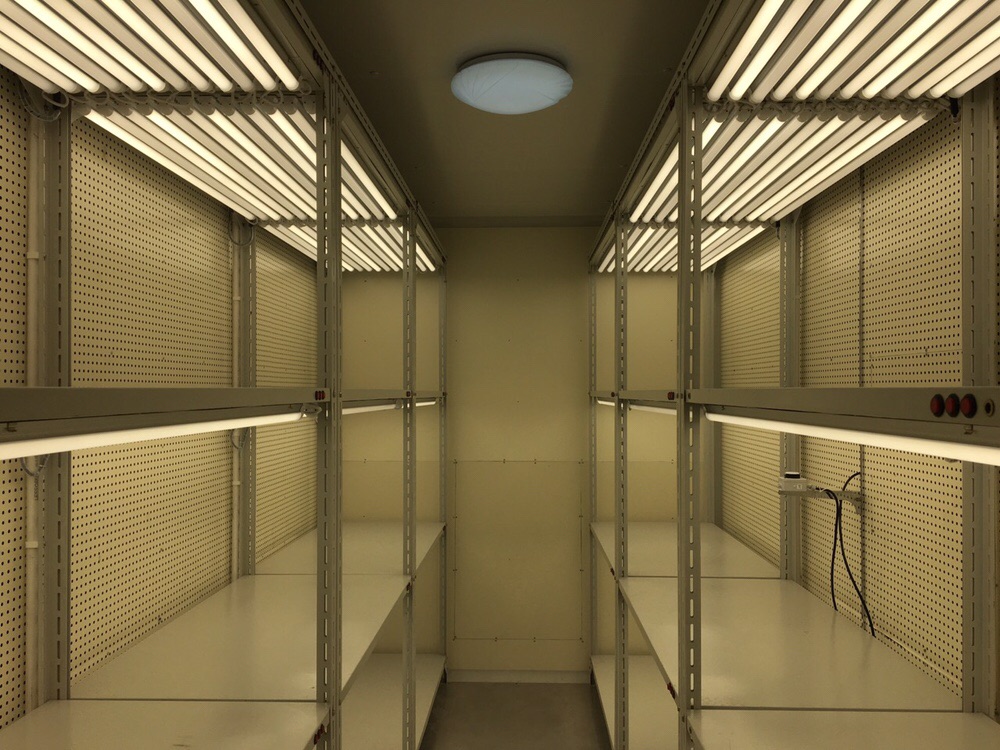
Lighting System
1. Agricultural sodium lamps and metal halide lamps
Agricultural sodium lamps are suitable for cultivation experiments involving tall crops (such as corn, with maximum light intensity not exceeding 100,000 LUX at 900 mm below the lamp). The accompanying rack serves as a seedling bed (constructed with stainless steel, featuring four vertical columns and a single-layer shelf, standard dimensions: 1200×600×1800 mm, with shelves bolted to the columns and shelf height adjustable as needed). Mounting method: Mushroom nails secured to the top of the insulation board.
2. Fluorescent lamps (T5, T8)
T5 and T8 lamps are suitable for cultivation experiments involving low-growing plants and small crops, with maximum light intensity not exceeding 25,000 LUX (at 100 mm below the lamp). The corresponding rack is a cultivation rack (constructed with universal angle steel, featuring four vertical columns and multi-tiered shelves, accommodating up to 12 lamps per tier). Standard dimensions: 1200×600×1800mm. Shelves are bolted to the columns, and shelf height is adjustable as needed).
3. LED lamps
LED lamp: Utilizing LED as its light source, the LED lamp replaces sunlight—which plants require for growth according to natural patterns—to create an optimal environment for plant development.
LED grow lamps help shorten the growth cycle of plants because their light source primarily consists of red and blue light. These lights utilize the wavelengths to which plants are most sensitive: red light wavelengths of 620-630nm and 640-660nm, and blue light wavelengths of 450-460nm and 460-470nm. These light sources optimize photosynthesis in plants, enabling them to achieve optimal growth conditions. Both experimental and practical applications demonstrate that, beyond supplementing light during periods of low illumination, they also promote the development of multiple lateral branches and bud differentiation during plant growth. This accelerates the growth of roots, stems, and leaves, enhances the synthesis of carbohydrates and vitamins within plants, and shortens the overall growth cycle.